
UY-301
HS-IIoT platform: a 4th-generation industrial SCADA
An end-to-end, sensor-to-cloud system that monitors power, generators and water in real time, raises alarms by priority to ISA-18.2, and keeps a complete history even when the site loses its internet connection.
Images and interfaces
Case study sections
What it does
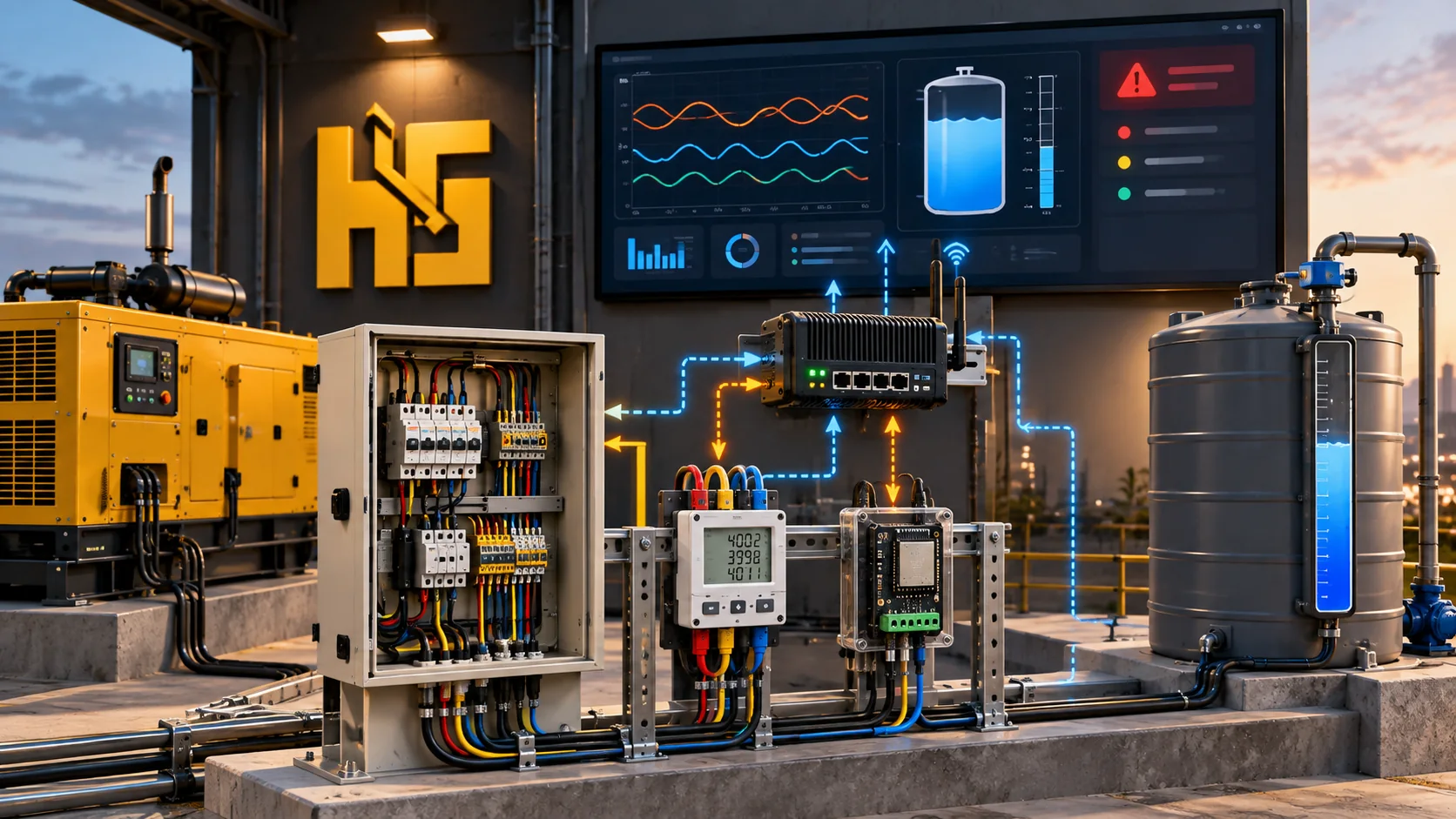
HS-IIoT monitors the electrical supply, generators and water of industrial and commercial sites in real time, raises alarms by priority, and keeps a complete history even when the site loses its internet connection. It is layered: field nodes measure; a site gateway collects, filters and forwards; the server stores, evaluates alarms and serves the user interfaces.
Power nodes
- ESP32 with three PZEM-004T meters (one per phase) and a panel temperature and humidity sensor.
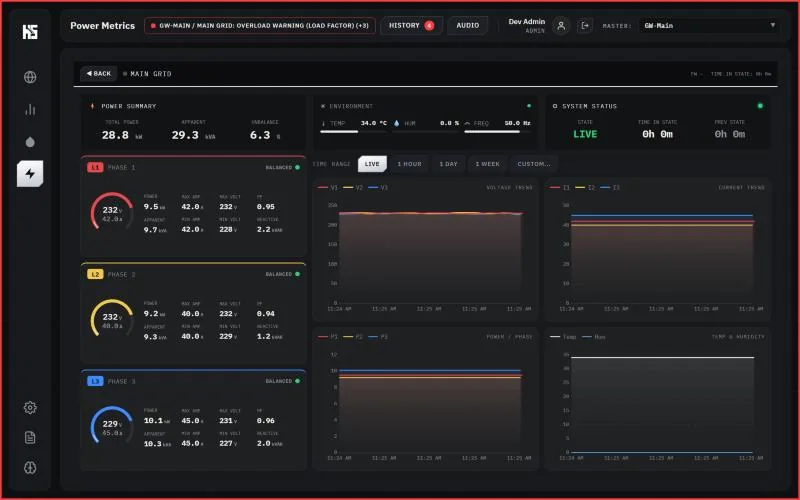
- Voltage, current, active, apparent and reactive power, voltage and current unbalance, power factor, estimated neutral current, load factor, energy and session peaks.
- Plausibility checks: a reading no meter can produce is dropped before it reaches the peaks or the cloud.
- Generator role: a virtual ECU computes run hours, fuel consumption, frequency stability, an engine health score and the oil and filter countdown.
Water nodes
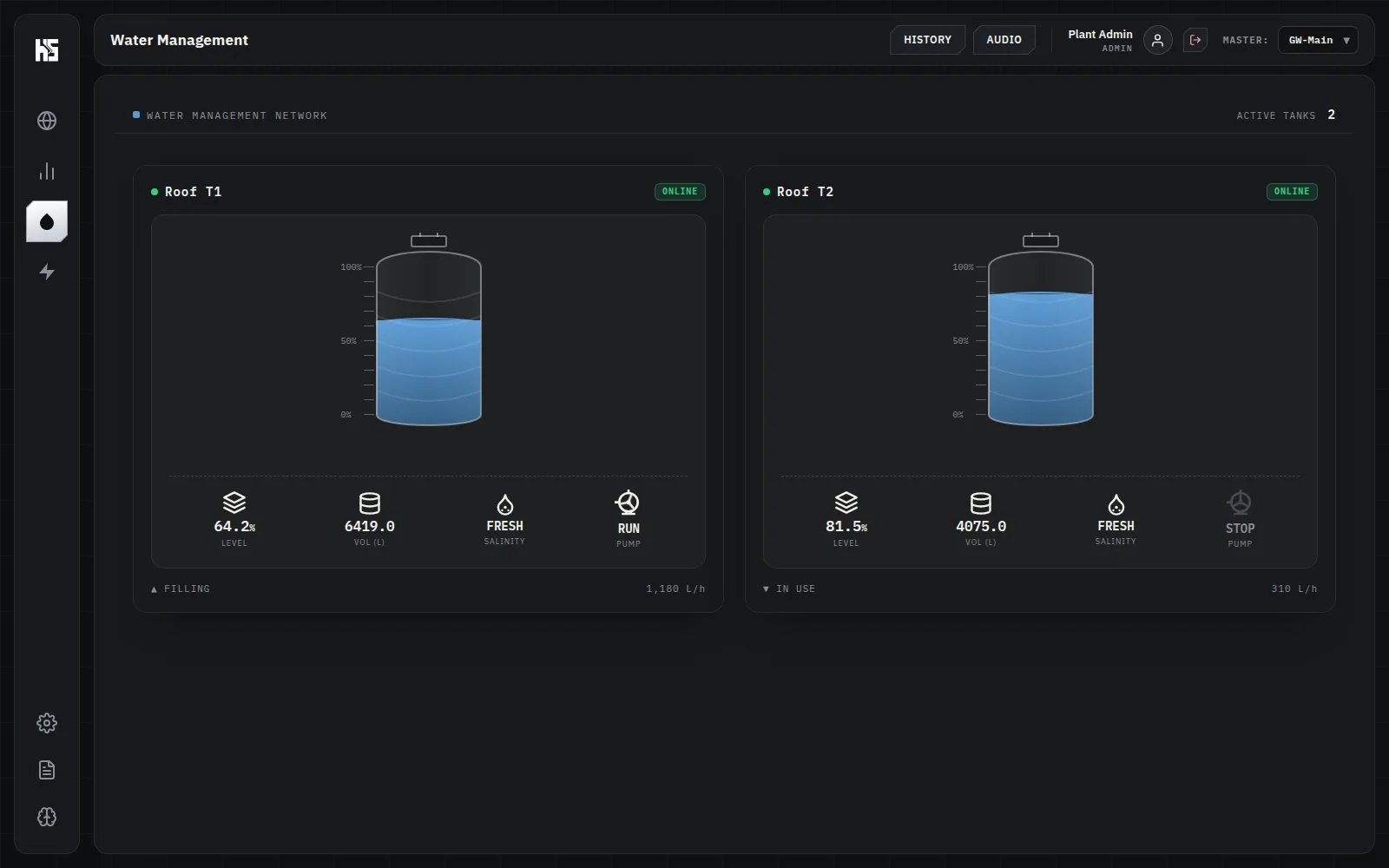
- Up to four tanks per node: ultrasonic level, TDS compensated for water temperature, and pump control.
- Each reading is the median of five pings, and a big jump is believed only when three readings in a row agree, so a splash or an echo off a pipe does not move the level.
- Automatic pumps run between two levels and never on a guess: when the level cannot be trusted, they stop.
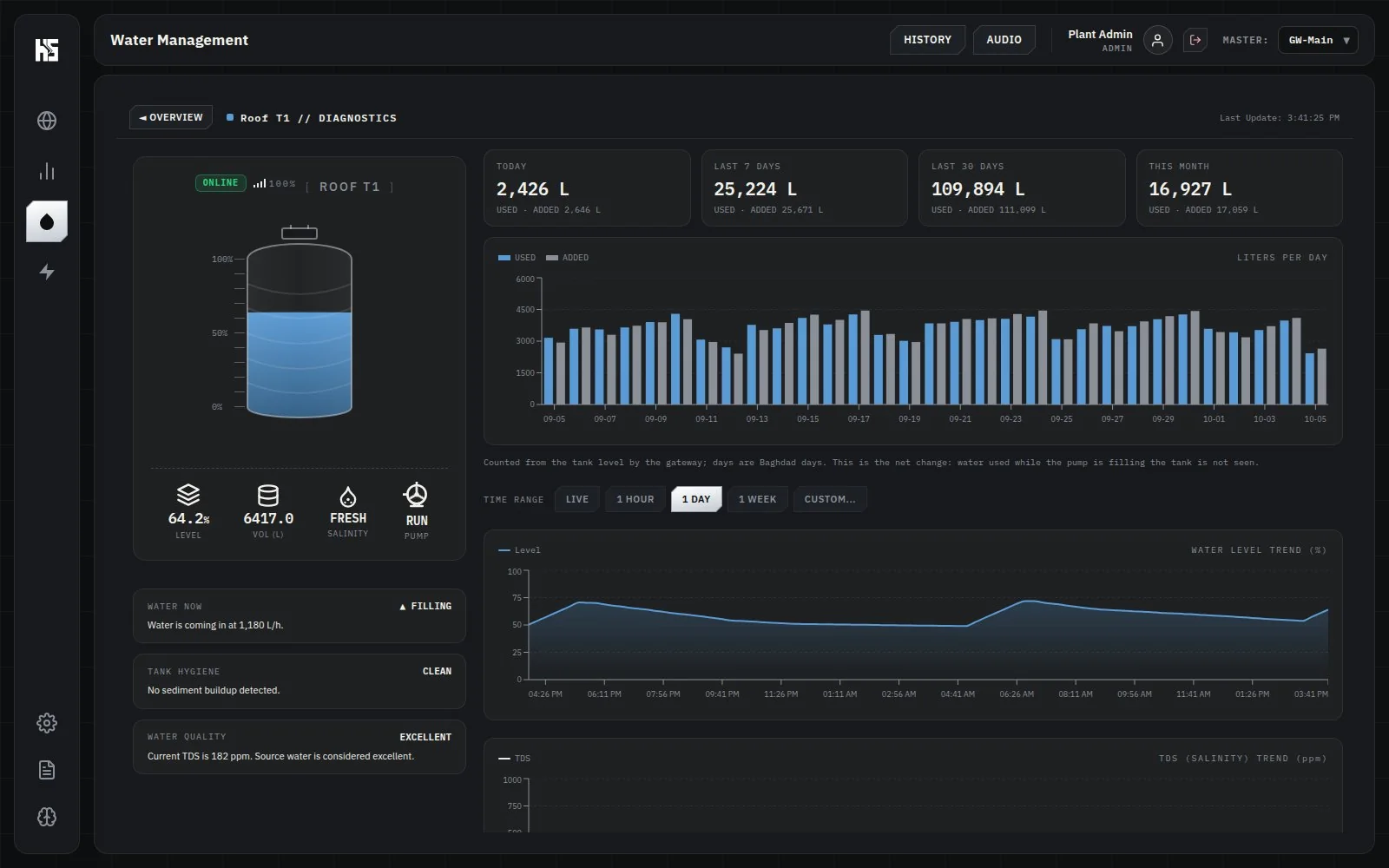
- No flow meter needed: the gateway derives the litres filled and used from the level, and the dashboard shows consumption per day, week and month.
The site radio network
Nodes talk to their gateway over ESP-NOW, directly, without a router: up to 10 nodes per gateway, 100–200 m outdoors and close to a kilometre with an external antenna. The gateway accepts data only from paired nodes, and nodes follow the gateway's channel on their own.
The gateway
- Edge filter: drops impossible readings and forwards only what really changed (deadband), so no bandwidth is wasted.
- One configuration document owned by the gateway: limits, CT ratios, tanks and generator data, edited from the local HMI or the dashboard and applied with an acknowledgement.
- CloudQ: every reading is written to a journal on a microSD card before it is sent and kept until the server confirms it is stored. After an outage a full day of backlog is delivered in about a quarter of an hour, and each message is stored exactly once.
- A secure link to the server over WireGuard, with a supervisor that brings the tunnel back after network changes.
- Over-the-air updates with probation: if the new firmware crashes or cannot reach the server within two minutes, it rolls back on its own.
- A local HMI to ISA-101 that works without internet, with operator and engineer access levels.
ISA-18.2 alarm management
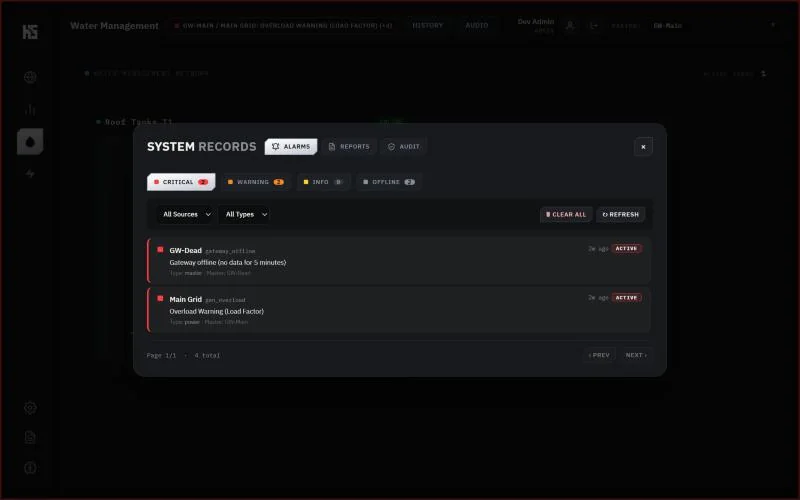
One alarm system on the server for every gateway, following ISA-18.2 / IEC 62682 and the EEMUA 191 targets:
- Three priorities (critical, warning, information), each alarm with its consequence and the operator's action.
- State-based suppression: a de-energised source raises no electrical alarms, and an offline source raises only "offline".
- On and off delays, handling of repeating alarms, and alarm floods summarised in one message.
- Channels: the dashboard, browser push, Telegram, and SMS / WhatsApp escalation for critical alarms.
Dashboard and public site
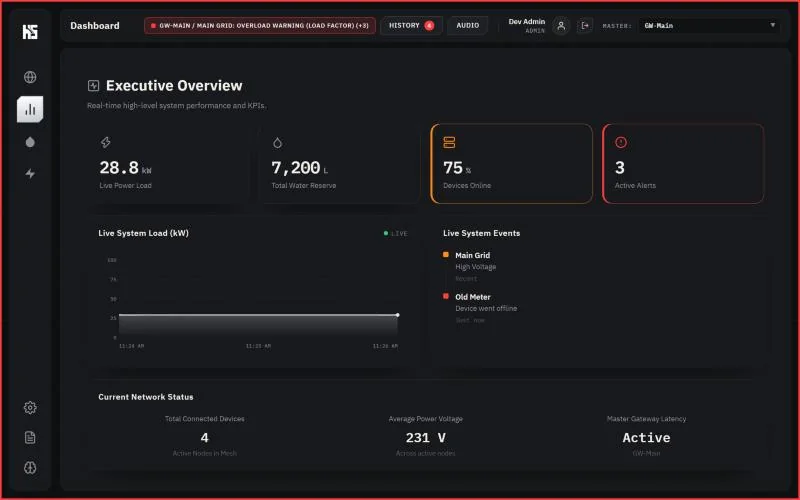
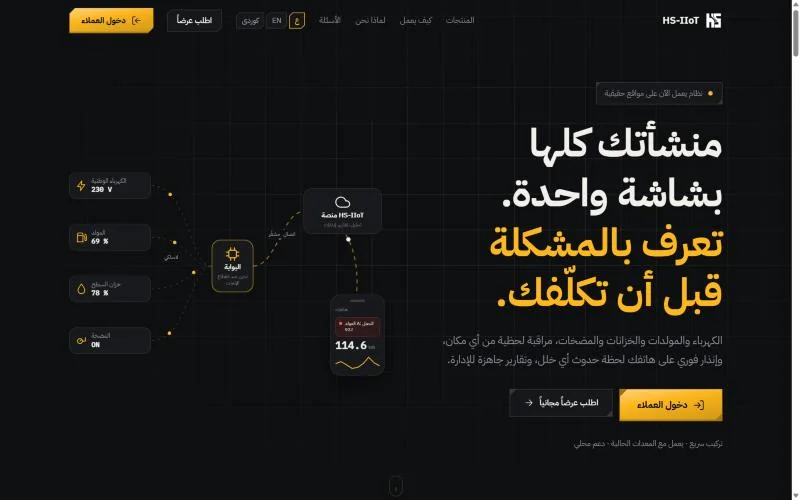
- A React dashboard to ISA-101: a neutral interface with colour only for deviations. Gateway map, executive overview, power and generator details, tanks, records and settings, with roles, per-device access and an audit log.
- AI insights through n8n and OpenAI: an efficiency score, an operator briefing, anomalies against IEC/IEEE limits, root-cause hypotheses, predictions and recommendations, with Arabic translations.
- A trilingual public site (Arabic, English, Sorani Kurdish) managed entirely from the dashboard.
Reliability and quality
Security measures aligned with IEC 62443, watchdogs on every device, deployments with a health check and automatic rollback, and 172 automated server tests plus 12 firmware test programs.