
06 · TK-101 · Projects
Adaptive control lab: MRAC with the MIT rule, PID and pole placement in MATLAB
A series of MATLAB and Simulink experiments: direct and indirect model reference adaptive control (MRAC) with the MIT rule, then a PID controller compared with plain unity feedback, then state feedback by pole placement with a steady-state gain correction.
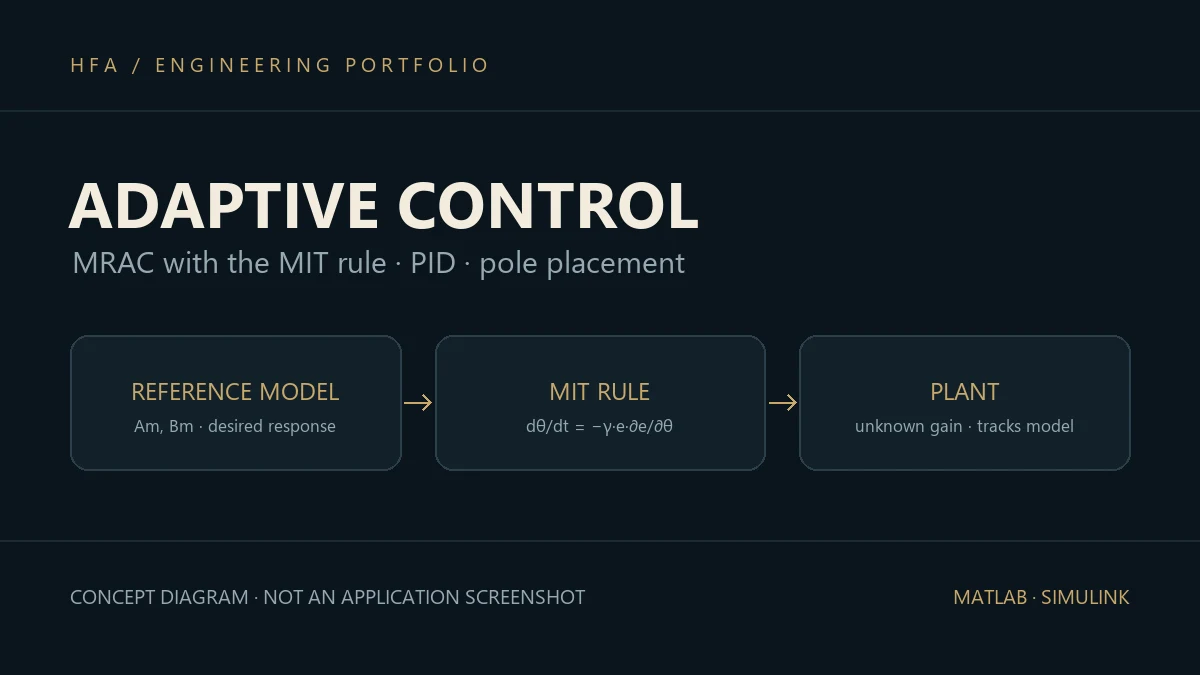
The problem
A classic controller is designed around known plant values such as gain and pole locations. In practice these drift with load, temperature and wear, and performance drifts with them. Adaptive control answers this by letting the controller adjust its own parameters while it runs.
Solution and data flow
- Direct MRAC with the MIT rule: a reference model defines the desired response, and the error between the plant output and the model output tunes the controller gain by the MIT rule (
dθ/dt = −γ·e·∂e/∂θ) until the plant follows the model even though its gain is unknown. - Indirect MRAC: the plant is in state-space form, its parameters are estimated online, and the control law
u = k₁x + k₂ris computed from those estimates, against a stable reference model (negativeAm,Bm = −1/Am). - PID: a second-order plant
G = 1/(s² + 2s + 3); its step response under unity feedback is compared withpid(Kp, Ki, Kd)to study how each gain changes overshoot, settling time and steady-state error. - Pole placement: controllability is checked with
rank(ctrb(A, B)),placemoves the poles to−0.5and−1.5, and a feed-forward gainkr = 1/dcgainremoves the steady-state error.
Implementation and challenges
The models are built in Simulink with state-space blocks, the calculations are MATLAB scripts, and the reports were written in English. The clearest lesson from the indirect experiment is that gain choice decides the outcome: with an initial k₂ = −1 the plant stayed close to its own behaviour, while −0.1 let adaptation force it to track the model. With unstable plant poles the output drifts away from the model, as the theory predicts. These are simulation experiments from a university lab.
Skills developed
Direct and indirect MRAC, the MIT rule, PID design and tuning, state-space modelling, controllability and pole placement, and modelling in Simulink.